- Home
- Palms in U.S.
- Palms of Texas
Palm trees of texas - Where They Grow Best
Texas may bring to mind cowboys, rodeo, and space exploration. So no, Texas might not be the first place people think of for palm trees!
But the state's range of climates means palms grow successfully almost everywhere except the high northern Panhandle. From the humid Gulf Coast to arid West Texas and the Trans-Pecos region.
The right palm species can be successful in nearly every Texas climate zone. The key is to match the palm to your local conditions.
We're taking a look at where palms grow best in Texas - climate zones, regional differences, and the most common palms you'll see in the state.
Feeling overwhelmed by palm tree problems or confusing information?
You’re not alone! At Mission: Palm Trees, we help everyday palm lovers grow, care for, identify & enjoy palms without baffling jargon or exhausting research.
We do the Authentic Research by cross-checking botanical data, while making palm tree info interesting & more fun to know.
Where Palms Grow Best in Texas
Texas contains USDA Hardiness Zones 6b through 9b, which is a huge range for one single state. The best, the most successful palms for Texas come down to one vital factor: winter low temperatures.
These regions are where you'll find most palms:
- Gulf Coast (Houston, Galveston, Corpus Christi, Brownsville): Zones 9a-10a. With a humid subtropical climate and mild winters. The most favorable region for palms in the state, supporting the widest variety of species.
- Central Texas (Austin, San Antonio): There are occasional hard freezes, but it's generally palm-friendly for species holding to zones 8b-9a. Especially cold-hardy species.
- North Texas (Dallas-Fort Worth): Zone 8a. It's the toughest area for palms because in the winter, occasional Arctic blasts (those "Blue Northers") arrive bringing hard freezes. Only the most cold-hardy species are generally able to survive here.
- West Texas (El Paso, Midland): Zones 7b–8b. This area is arid, with low humidity and big temperature swings. Low rainfall and dry air actually help drought-hardy palms endure.


Common Palm Species in Texas
You'll consistently find a handful of species across the state. These can do well in their area because they are suited to that area.
Texas Sabal Palm
Sabal mexicana is the only palm native to Texas. Other common names are Mexican Palmetto and Texas Palm. This fan (palmate) palm grows naturally in the Rio Grande Valley.
HEIGHT: Up to 60ft/18m tall.
GROWTH SPEED: Slow.
It tolerates heat and drought. While withstanding cold temperatures down to 15°F/-9.4°C for a short time. Zones 8b-11.
As members of the International Palm Society (IPS), we attended their sponsored trip to the sanctuary created specifically for this species, in the Brownsville area. Those growing there are the remnant groves from the whole range of South Texas, because of land clearing for farming.
 Sabal mexicana palms in the Sabal Palm Sanctuary in Southernmost TX.
Windmill Palm
Trachycarpus fortunei is the most cold-hardy fan palm widely planted in Texas. Your go-to choice for North and Central Texas. Other nicknames are Chusan Palm and Chinese Windmill Palm.
Quite sturdy, it typically survives temperatures well below freezing. It does best in zones 7b-11 (bearing temps as low as 5°F/-15°C), plus some success in 7a.
HEIGHT: Can get 50ft/15m tall, solitary trunk.
GROWTH SPEED: Medium.
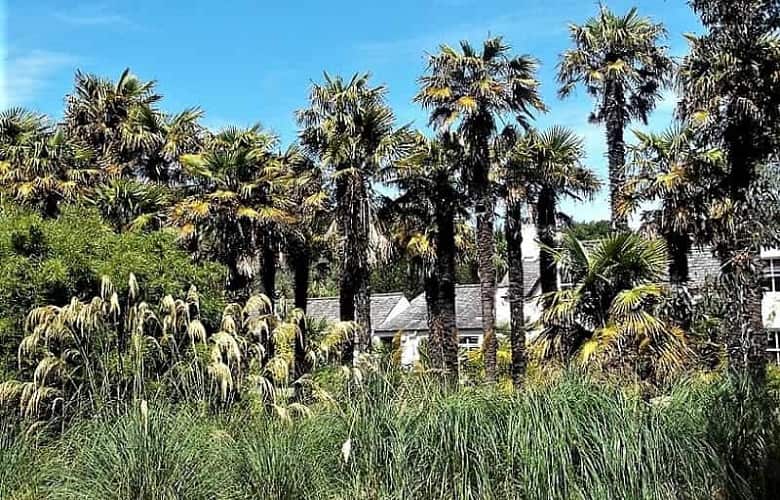 So cold-hardy - these Windmaill Palms are growing in England in the UK.
Mediterranean Fan Palm
Chamaerops humilis is popular with those living in West and Central Texas.
A compact, clumping palm with multiple trunks and stiff palmate leaves. It handles dry conditions well, and braves cold snaps, zones 8b-11 - even 8a in the arid west. Tolerates low temps to 10°F/-12.2°C.
HEIGHT: To 20ft/6m, while capable of spreading out 30ft/9m.
GROWTH SPEED: Slow to medium.
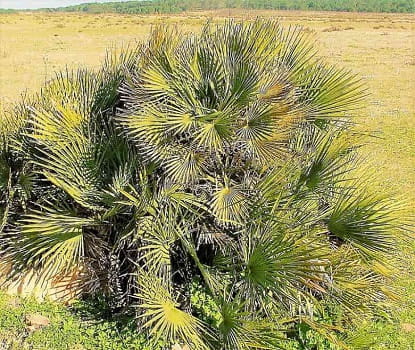 Also called European Fan Palm, it's often used as a privacy hedge
Pindo Palm
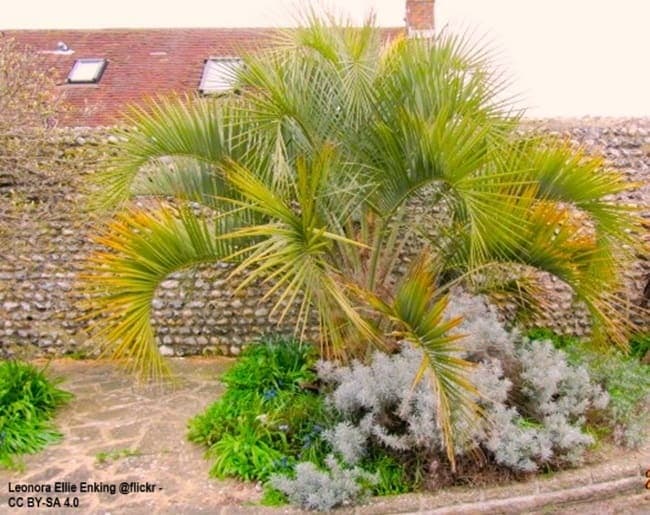
Butia capitata is another cold-hardy palm for Texas. Because of its edible fruit, it's also called the Jelly Palm.
- Good for USDA Zones 9-11. So temporary drops to 20°F/-6.7°C are doable.
- Commonly seen in Central and South Texas.
Some have distinctive blue-green color pinnate (feather) fronds. It also keeps a good chunk of old leaf bases that crisscross for an unusual trunk appearance.
HEIGHT: 35ft/10.5m tall, solitary trunk.
GROWTH SPEED: Medium, sometimes slow.
California Fan Palm
Washingtonia filifera is mostly found in warmer coastal and southern Texas areas. Suited for Zones 7-11, and temporary temperatures as low as 0°F/-17.8°C.
We were surprised when in South Texas, that this drought-tolerant palm grew all around. That's when we first discovered from a local IPS member that the area was actually mostly arid.
Its older palmate leaves are kept around, when dead and brown. One precaution for those thinking of growing one is that frond stems have harsh thorns.
HEIGHT: Up to 70ft/21m, solitary trunk.
GROWTH SPEED: Slow as a sapling, then speeds up with maturity.
 California Palm growing in this Cali parking area.
Recent Article


-
Where Are Palm Trees Native? Surprising to You?!
 Where are palm trees native? Were you wondering. Meaning where are they indigenous, endemic, or naturally originally from. You'll discover it!
Choosing the Right Palm for Your Part of Texas
Since Texas climates vary dramatically by region, the best palm for a Houston backyard is the wrong choice for El Paso.
To help you, we've broken down regional and use-specific guides so you can choose a palm with confidence. First know your growth zone - Find it Here by Your Zipcode>
Best Palms for Coastal Texas
Most of those common palms we mentioned above, the Texas Sabal Palm, Windmill Palm, Mediterranean Fan Palm and Pindo Palm do well along the Texas coast.
The regions near Texas coasts are mostly in USDA zones 9a-9b. Normally with humid subtropical conditions and sandy/clay coastal soils. Other top species to evaluate:
- Sabal palmetto (Cabbage Palm) is the workhorse of Texas coasts. Cold-hardy to around 10°F/-12.2°C. Zones 8-11 best, can manage 7b with winter protection. Tolerates wind, and both drought and occasional flooding. Naturalized groves live in jungly areas.
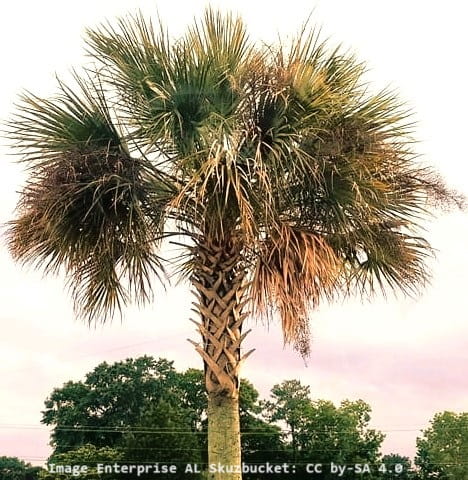 Nice round crown on the S.palmetto, handsome isn't it?
- Washingtonia robusta (Mexican Fan Palm), loved ornamentally for fast the tall, dramatic silhouette. Less cold-hardy than Sabals or W.filifera, cold-spell damage occurs below 20°F/-6.7°C. Not very Houston-reliable, but further south along the coast works well.
 Mexican fan palms growing all around this Tucson AZ shopping center.
- Phoenix dactylifera (Date Palm) has those delicious edible dates. Most suitable for Texas zones 8-11, where the lowest cold-spell temperatures don't go below 10°F/-12.2°C.
 Have you ever tried dates from the P.dactylifera? The grow them here.
- Phoenix canariensis (Canary Island Date Palm) are loved in landscapes. With its wonderful round crown and a classic resort look. Best zones 9-11, like Corpus Christi and south. Trying them in more northerly Texas areas is risky if your winter temperatures can get below 15°F/-9.4°C.
 This P.canariensis is doing fine in San Simeon, Northern California
Consider Salt in Coastal Areas
If you live very near sandy beaches along the Gulf of Mexico, consider the palm's toleration of salt spray. Most palms get injured by salt. But Sabal palms and Washingtonias generally do well.
Yet the winner is the Coconut Palm (Cocos nucifera).
Best Palms for West Texas
West Texas is a completely different ballgame from the coast. Think El Paso, Midland-Odessa, the Trans-Pecos and Permian Basin.
You're dealing with USDA zones 7b-8a. Low humidity, big temperature swings, alkaline/caliche soils, and occasional hard freezes into the teens or single digits are the challenges.
Cold hardiness and drought tolerance matter here. Those most successful are:
- Mazari Palm (Nannorrhops ritchiana), a great fit because it's a natural in arid, cold desert conditions (since it's native to Afghanistan/Pakistan highlands). Extremely cold-hardy (down to near 0°F/-17.8°C) and naturally drought-tolerant. It spreads, with clustering trunks.
 Mazari Palm growing in a botanical garden. It can get 20ft/m tall.
- Windmill Palm (mentioned above) is about the most popular and reliable palm for the region's 7-11 zones. It's manageable in harsh, dry conditions. The go-to palm for El Paso.
These palms are solid secondary choices for West Texas.
- European Fan Palm (mentioned above) is quite cold-hardy and handles West Texas routine dry periods well.
- Pindo Palm (mentioned above) is somewhat marginal here. Those in warmer microclimate pockets (like El Paso's lower elevations) can do reasonably well.
- California Fan Palm (mentioned above) is better suited to arid conditions and cold snaps than its W.robusta cousin. Seen in some West Texas landscapes where there's irrigation.
Not a Palm: Yucca and Dasylirion
Because many West Texans sometimes use "palm" loosely when they're viewing or speaking of a Yucca or Dasylirion species. These plants do dominate the Texas landscape.
These spiky, desert-tough plants are often mistaken for palms, but they belong to entirely different plant families.
- True palms belong to the family Arecaceae and produce fan- or feather-shaped fronds.
- Yucca and Dasylirion (or Sotol) are desert succulents in the Asparagaceae family with sword-like or ribbon-like leaves.
 One type of Yucca growing near El Paso TX.
These plants look palm-ish from a distance, but botanically they're not related to palms. See their detail comparisons:
| Feature | True Palms | Yucca | Dasylirion (Sotol) |
|---|---|---|---|
| Plant Family | Arecaceae | Asparagaceae | Asparagaceae |
| Leaf Shape | Fan-shaped or feather-shaped fronds | Stiff, sword-shaped, pointed tips | Thin, ribbon-like, grass-like |
| Leaf Edges | Smooth or lightly fibrous | Smooth to slightly fibrous | Fine hooked teeth along margins |
| Flower Type | Branched clusters (inflorescences) | Tall spike with bell-shaped white blooms | Tall, slender plume |
| Trunk | Single, unbranched, fibrous | Can be trunked or trunkless; woody | Short, woody base; often trunkless |
| Growth Habit | Tree-like, tropical/subtropical | Rosette form, desert-adapted | Rosette form, desert-adapted |
Frequently Asked Questions for Palm Trees of Texas
Can palm trees survive in North Texas winters?
Can palm trees survive in North Texas winters?
Cold-hardy palms for Texas Winters are winners for North Texas. They can survive temperatures that go below freezing for a limited time.
Check on Those to Choose From, according to your own climate zone's cold tolerance.
Do palm trees grow in West Texas?
Do palm trees grow in West Texas?
Yes, they can.
But the variety that do well there are restricted by the climate. If you live in West Texas and are considering Planting a Palm Tree, see more About West Texas Palms.
What are the best small palms for Texas yards?
What are the best small palms for Texas yards?
There are several small palms that are suitable for Texas yards.
But before deciding on which you'd like to have on your property, it's essential to know Your Own USDA Climate Zone. You'll need to compare typical lowest cold-snap temperatures in your area with the lowest tolerated temperature for a palm tree you are considering.
Then you'll know which will do well around your home.
Takeaways for Palm Trees of Texas
Texas can successfuly grow many varieties of palms. However it's a huge state with many climates, so the most important thing to start with is knowing the best palms for each region of Texas, and what your local climate zone is.

About the Authors: Karen McGowan is the creator of MissionPalmTrees.com, and The Palm Species Navigator, along with her husband Bill. Where they share easy to read palm tree expertise gained from years of finding and studying palms in varied climates. So readers will know palms, and can avoid costly palm planting mistakes. Learn more.
Check out these articles:
Landscaping Around a Palm Tree that Looks Polished
Landscaping around a palm tree is easier with layered plants, edging, color, and climate-smart ideas that make one standout palm feel finished.
Where Do Palm Trees Grow? Maybe More Places Than You Thought!
Wondering where do palm trees grow? For sure it's the tropics & subtropics. They're more versatile than that, though. Even doable for temperate regions.
Landscaping With Palm Trees - Ideas & Top Tips!
Transform your yard when you discover our easy landscaping with palm trees ideas, perfect for any skill level. See simple designs that make a big impact.


We Love Arizona Where Palm Trees Grow & We Love Helping Others Appreciate Them Too!
Member of Local First Arizona - Supporting Local Businesses Wherever They Are!
Privacy Policy> | Terms/Conditions/CC Licenses> | Advertising Disclosure> | Contact Us>
Copyright © 2022 - MissionPalmTrees.com All Rights Reserved

Do Not Copy - No use is permitted without permission. Scraping the contents of MissionPalmTrees.com website for the purpose of AI (artificial intelligence) LLM (large language model) training is strictly forbidden. Mission: Palm Trees Name & Logo Registered in the U.S. State of Arizona
As an Amazon Affiliate we earn from qualifying purchases.
A Production of Picture Rocks Networking LLC
This site is protected under U.S. and International copyright laws.