- Home
- So Many Species
- Coconut Palm
Coconut Palm Tree
The coconut palm tree is likely the world’s most recognizable tropical plant.
Known for its tall curved trunk, feathery fronds, and the coconuts it produces high above the ground. Since it's found in warm coastal climates, the coconut palm has become a symbol of beaches, islands, vacations, and tropical landscapes.
But there’s much more to this palm species than that. Our coconut palm tree guide helps you understand how these palms grow, where they survive best, and how & when coconuts develop.
Whether you’re interested in tropical landscaping, palm identification, or simply learning about the coconuts, this guide explains the essentials clearly and realistically.
Feeling overwhelmed by palm tree problems or confusing information?
You’re not alone! At Mission: Palm Trees, we help everyday palm lovers grow, care for, identify & enjoy palms without baffling jargon or exhausting research.
We do the Authentic Research by cross-checking botanical data, while making palm tree info interesting & more fun to know.
A Coconut Palm Tree at a Glance
Some people have wondered How a Palm Compares to Coconut Trees. Here's an overview of essential facts about coconut palm trees that will get you started on that.
Scientific Name - Cocos nucifera [koe kose - new sif er ah]. In the subfamily Arecoideae's tribe Cocoeae.
- Several cultivated varieties add onto that Taxon (biological name): C.nucifera 'Fiji Dwarf' - C.nucifera 'Golden Malayan Dwarf' - C.nucifera 'Jamaican Tall' - C.nucifera 'Nino' - C.nucifera 'Panama Tall' - C.nucifera 'Red Spicata Dwarf' - C.nucifera 'Yellow Malayan Dwarf' - C.nucifera 'Cocos Maypan - C.nucifera 'Green Malayan Dwarf'.
Native Region - It's unproven where Coconut Palms originated. It's thought that most likely its beginnings were on South Pacific Island coasts. There's some evidence for it growing in the Philippines likely before 224 BC.
Cold Tolerance - A coconut palm tree is totally a tropical plant. It's almost always not likely to survive frosts below 35oF/1.7oC that last for any length of time. Once temperatures go below 40oF4.4o/C it cannot produce energy.
Height - Reaches at least 30ft/9m, but those you see will be about 100ft/30m tall. Of course the cultivars' height will be variable, from "dwarf" to "tall."
Growth Speed - From a medium rate to quite fast. Depending on its microclimate and care.
Coconut Production - All healthy Coconut Palm Trees are capable of producing coconuts. Their ripe oblong shape with three spherical wedges (sections) can be green, yellow, or orange, all eventually turning brown. Its seed is the Coconut, Which Grows Pretty Easily.
USDA Zones - Primarily 10b-11.
Identifying the Coconut Tree
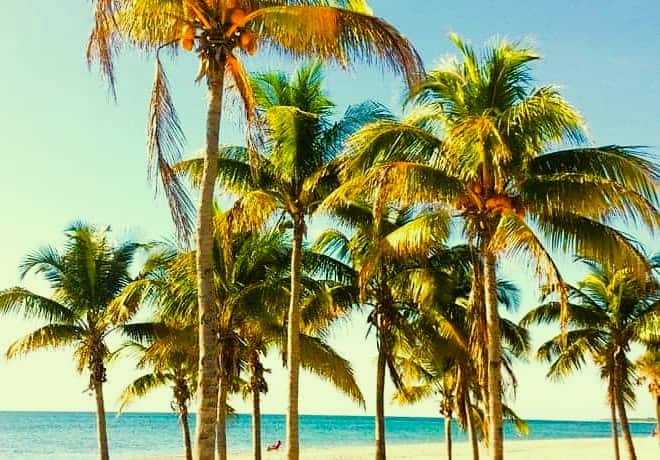
Most people can easily tell it's a coconut palm tree, as once it begins producing its fruits, the coconuts will be seen in bunches at the lower part of the leaf crown. It's probably the easiest palm tree of all that you can identify right away.
But let's see it's main features, which are used to confirm coconut palm identification.
FRONDS: The leaves are feathery pinnates. They grow up to 15ft/4.5m out from the trunk. Dark green to yellow-green. 20-30 in the crown.
TRUNK: A thinner radius, at 1ft/30cm thick. The bottom swells out thicker. Color is smoothly white or tannish, with rings. Matted near the top. It often tilts or slightly bends.
FLOWERING: Light Yellowish flowers grow from stalks (inflorescence) grow amidst the crown. Which will produce the familiar coconut fruit.
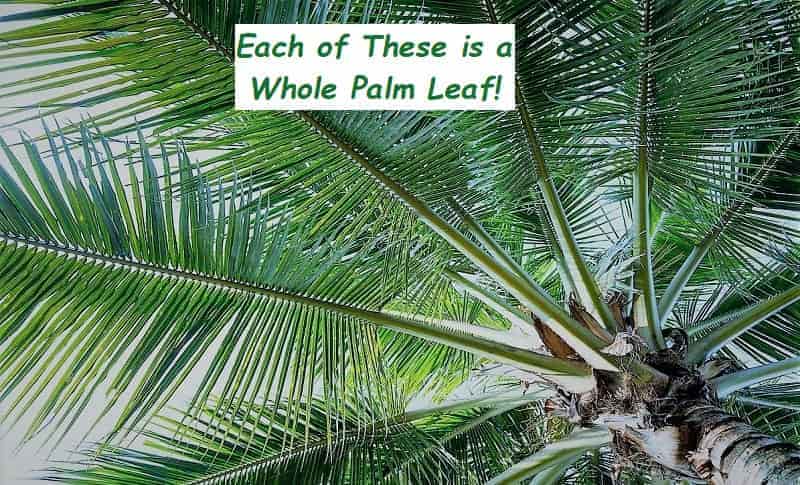 Not branches, they're fronds.
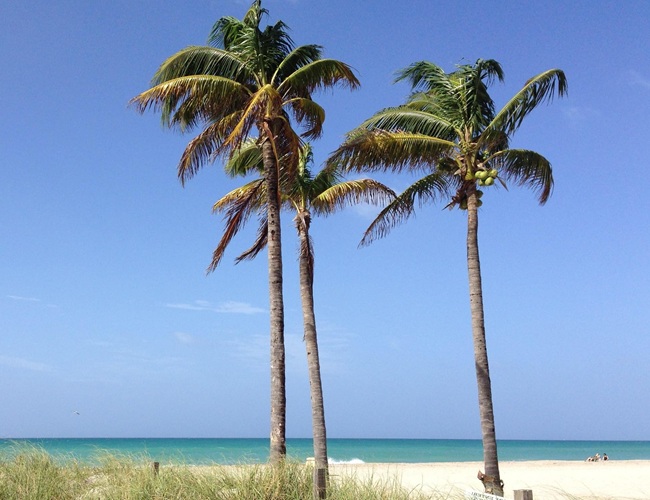 Narrow trunks of Coconut Palms
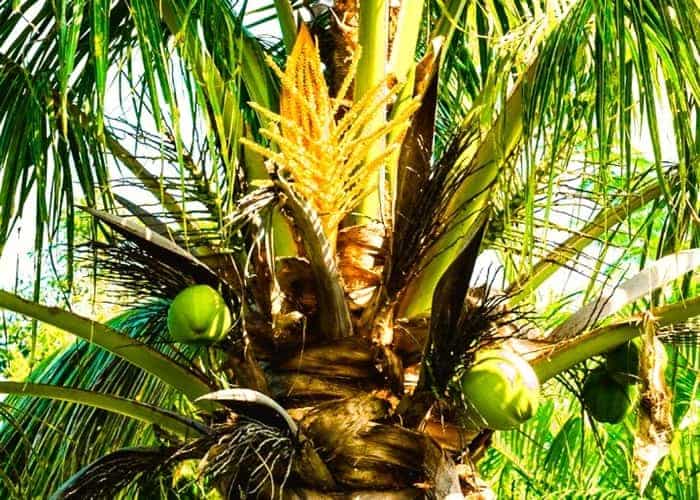 Yellowish flowers ready.
Coconut Palm Tree Growth & Climate Details
CLIMATE ZONES: Only suitable for the tropics, and semitropical climate zones 10b-11. Where the lowest temperature the area ever reaches is 35oF/1.7oC.
The coolest microclimates slow down its growth, and flower production stops - meaning no coconuts to come! Cultivars are being developed to tolerate lower temperatures. For instance, a 'California Coconut' growing in Newport Beach CA is about the northern-most coconut Palm Tree Species in the U.S.
 Coconut Palm Trees only do well in specifically tropic areas - where there' no frosty days.
LIFE SPAN: The coconut tree can live as long as 100 years. Normally at least to 60 years. Dwarf varieties don't live as long, but generally at least 60 years.
TOLERANCES: C.nucifera is surprisingly drought tolerant, and not much fussy for the soil it's in. As you can imagine, it is a sun-lover. It does well with typical Fertilizer for Palms. One place it can't easily tolerate is Growing Potted Indoors.
FRUITING: With tall versions of the coconut palm, flowering into fruiting (the coconuts) begins anywhere from 6-10 years old. The short version begin flowering sooner, within 3-5 years.
ONCOMING SENESCENCE (OLD AGE)
At 60 years old all coconut trees start losing their reproductive ability - you could think of it as Cocos nucifera menopause! No more flowers = no more coconut fruit. Some small cultivars enter those nonproductive years as early as 40 years old.
Plants (MDPI, 2022) published a peer-reviewed study that found coconut producers are dealing with an annual coconut fruit production decrease of 50–70% from palms in their plantations. It confirmed that coconut palms' economic productivity tends to decline years before death.
Coconut Palm Trees in the Landscape
Most of us (if not all!) have noted when Taking a Vacation to the Tropics, that Cocos nucifera is ubiquitous. All over the place - but the closer to the beach, the more of them you're likely to see.
In the United States, the Primary Area for Coconut Palms is Florida. Yet they're in tropical climates all over the world.
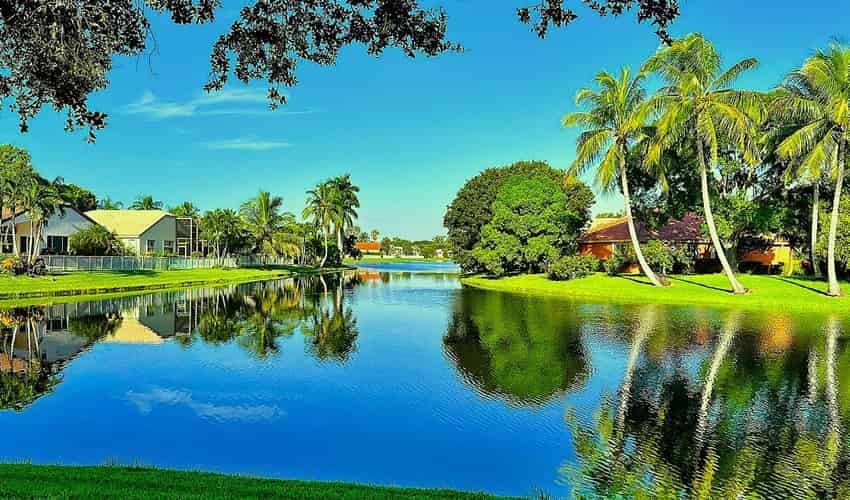 Coconut palms growing in lakeside property landscapes.
For a palm, they're really tolerant of salt spray. Which is why they're typically on beachfront properties, including resorts. They do well in locales, which tend to get lots of rain feeding groundwater. But with continuous flooding they can suffer.
It's important to be aware of their susceptibility to attack.
- Problematic pests: Palm aphid, coconut mite & red ring nematode
- Problematic disease:
- The base C.nucifera palm was continuously endangered by Lethal Yellowing. Now some cultivars are resistent to That Phytoplasma Bacteria.
- Caution is needed for fungal problems like phytophthora bud rot & ganoderma.
- Physiology problem: Watch for potassium deficiency.
Just released:


-
Where Are Palm Trees Native? Surprising to You?!
 Where are palm trees native? Were you wondering. Meaning where are they indigenous, endemic, or naturally originally from. You'll discover it!
Useful Coconut Products
The Coconut Palm has always been a valuable plant that's supported families and economies up through today. It's cultivated in plantations.
All parts of this tropical palm are useful, like the inner liquid called coconut water. Other useful parts are:
COPRA: The meat inside the coconut shell.
- It's dried and used as a food product for various recipes.
- It's processed to extract oil from it.
- Also used in making coconut milk and cream.
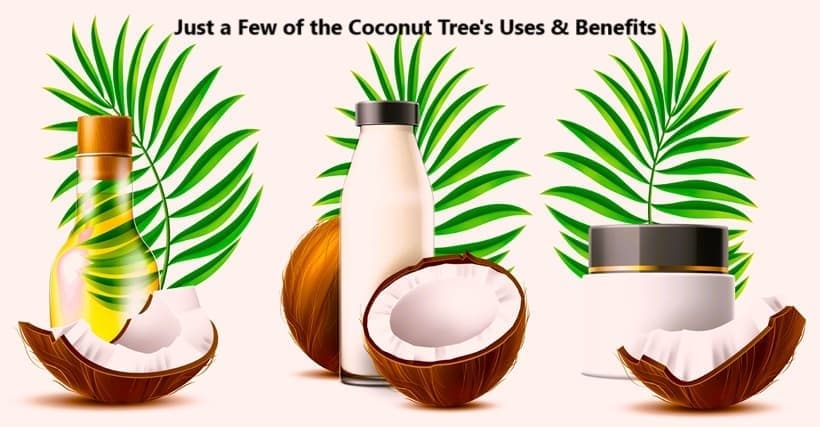 Coconut meat, milk & water are for consumption. Beauty producst for - you know!
COIR: The outer rough, fibrous covering of the coconut.
- Used in manufacturing a variety of items.
- Used as mulch around plants (including palms).
- Mixed into some soils for enrichment.
LEAVES: Useful for weaving into practical products, like roof thatch, baskets, mats and clothing.
TRUNKS: Useful as lumber for homes and furniture projects.
See More about the multiple Uses and Benefits Obtained from the Coconut Tree.
Coconut Palm Tree - the FAQs
Do Palm Trees Have Coconuts?
Do Palm Trees Have Coconuts?
No - all palm trees do not produce coconuts. Only one palm species, Cocos nucifera (the coconut palm tree), actually grows coconut fruit.
Palms like the date palm, the areca palm, the windmill palm, and thousands of others are entirely coconut-free. And the palms you notice in California or Arizona aren't coconut palms and will never produce a coconut.
So every coconut tree is a palm tree - while other kinds of palm trees are definitely not coconut trees.
Since Cocos nucifera is sometimes called a Coconut Tree, it can be misconstruced to mean all palm trees have coconuts. Understandable confusion, since the two terms are often used equivalently in everyday language.
Yet Coconut Palms do have multiple varieties - many "cultivars" developed to resist the most dangerous disease that can hit: Lethal Yellowing. Some cultivars are as tall as the basic Cocos nucifera, but others are much shorter.
See our section with more details of Coconut Palms at a Glance.
Are Coconuts Fruits, Nuts or Seeds?
Are Coconuts Fruits, Nuts or Seeds?
Botanically, a coconut is accurately classified as a fruit.
Specifically it's a drupe (sometimes called a stone fruit). The Library of Congress explains a drupe is a fruit with a hard covering enclosing a seed, just like with a peach or an olive. We have an article to Help Even Better Understand a Drupe.
As for Seed - A coconut can be called a seed. Plant one in the right conditions, and it sprouts into a coconut palm. The entire coconut (shell, meat, and water inside) is the seed.
As for a Nut - A coconut has a hard outer shell, so it looks and acts like a nut, generally speaking. The U.S. Food and Drug Administration (FDA) classifies coconuts as tree nuts for labeling and allergen purposes. Considering it a one-seeded fruit that grows on a tree. Yet botanically it's not a true nut.
So the short answer is:
- Botanically it's a fruit (drupe).
- Culinarily it's treated as a nut.
- And yes, it's also a seed.
All three, fruits, nuts and seeds are plausible - but fruit is the most technically correct answer.
How Do Coconuts Grow?
How Do Coconuts Grow?
Coconuts grow through a process that takes nearly two years from flower to harvest. Here's the basic steps to become a coconut:
- A coconut palm starts flowering between five and ten years old. The flowers emerge on a special stalk (the inflorescence) containing both male and female blooms.
- The palm's male and female flowers open at different times. Natually designed to ensure cross-pollination between different Coconut palms. Wind and insects help to pollinate female blooms.
- Coconut fruit takes from 11-12 months to emerge and fully develop. It progresses from a small green "button" to enlarging as it forms its inner water and soft jelly-like meat.
- Then finally, it's finished: the well-known product of firm white flesh.
A healthy coconut palm produces 12-15 inflorescences each year, about monthly. So you can harvest coconuts year-round from an adult Coconut Palm.
See more updates in our article: How Do Coconuts Grow?
How long does a coconut palm live and produce fruit?
How long does a coconut palm live and produce fruit?
A coconut palm is remarkably long-lived. Tall varieties - such as the Jamaican Tall or West Coast Tall - commonly live 80-100 years. Dwarf varieties typically live 30-50 years.
Coconut fruit production follows a predictable timeline:
- Years 5–10: The standard Cocos nucifera palm and other tall varieties begin bearing their first coconuts
- Dwarf varieties (cultivars) produce coconuts as early as 3–4 years old. They trade longevity for speed, fruit comes sooner but for a shorter overall period.
- Years 15–20: Peak output begins. A healthy palm now can yield 50-200 coconuts per year, depending on variety, climate, and care.
- Around year 80 fruiting stops for most tall palms, somewhat earlier for small coconut palms, at age 40.
Coconut palms are suited for USDA Hardiness Zones 10B-11. Those climates are best for long-term coconut production.
Tall coconut palms are sometimes called a "three-generation tree" because a single palm can sustain a farmer, their children, and their grandchildren. See more Details Around Growth, Fruiting and Area Suitability.
Where do coconut palms grow?
Where do coconut palms grow?
Coconut palms are fully tropical plants, so they grow naturally well in a narrow band centered at equator - roughly 25° north to 25° south.
They'll natural to coastal tropical regions across Southeast Asia, South Pacific, South Asia, East Africa, the Caribbean, and South America. The Philippines, Indonesia, and India are among the world's top coconut-producing nations.
In the United States, coconut palms only grow successfully in South Florida (primarily Miami-Dade County and the Florida Keys), Hawaii, and Puerto Rico. These are in USDA Hardiness Zones 10B-11.
Coconut palms (Cocos nucifera) have very specific needs: average yearly temperatures about 80°F/27°C), no frost, at least 2,000 hours of yearly sunlight, and at least 30–50 inches of annual rainfall. Unlike most other palms, they're very salt-tolerant. So they do very well along tropical coastlines.
The palms you see in California, Arizona, or most of Texas are not coconut palms. Their climates are too dry and/or too cold for Coconut Palm Trees to survive. See the best Landscapes for Coconut Palms, and what to watch out for.
What are coconut palms used for?
What are coconut palms used for?
Every part of coconut palm trees is useful.
From the fruit alone:
- Coconut water: clear liquid inside young coconuts, a natural hydrating drink.
- Coconut meat (flesh): eaten fresh, dried (copra), shredded, and transformed into coconut milk and coconut cream.
- Coconut oil: pressed from dried copra; used in cooking, cosmetics, soaps, and hair care.
- Coir: the outer fibrous husk; used to make ropes, mats, erosion-control products. And for gardening, used in potting soil and as mulch.
- Shell: used as fuel, charcoal, and crafted into utensils and bowls.
From the rest of the palm:
Fronds (leaves): For roof thatching, weaving baskets, and making brooms.
Trunk: Used in construction - buildings, and tropical furniture.
Sap: tapped to make palm sugar, vinegar, and Fermented Into Palm Wine.
The University of Florida IFAS Extension notes that the coconut palm is "the most economically important palm worldwide."
Takeaways for a Coconut Palm Tree
If you ever asked the question: Do Palm Trees Have Coconuts? - I hope we've answered your question. And like that we've given you even more.
In our article you've discovered where a coconut palm tree can live successfully, its age limit, the products that come from this plant, and tips for having one on your property.
REFERENCES.
Cocos nucifera at Palmpedia, palmpedia.net/wiki/Cocos_nucifera
Meerow, AW (2002). Betrock's Guide to Landscaping Palms. Betrock Information Systems, Hollywood FL
Riffle, RL (2008). Pocket Guide to Palms. Timber Press, Portland OR
Broschat TK, Meerow AW, Elliott ML (2017). Ornamental Palm Horticulture, second edition. University Press of Florida, Gainesville.
National Tropical Botanical Garden (2025) Cocos nucifera. Tropical Plant Database - Plant Details. At ntbg.org/database/plants/detail/cocos-nucifera
Simmons, B (2026) Spherical Wedge - Definition, Formula & Examples. Mathwords at mathwords.com/s/spherical_wedge.htm
Uhrin Brothers (2025, July 22). Cocos nucifera var. 'Malayan Dwarf': A comprehensive Growing Guide for Enthusiasts & Collectors. Viriar at viriar.com/blogs/palms-tree-encyklopedia/cocos-nucifera-var-malayan-dwarf

About the Authors: Karen McGowan is the creator of MissionPalmTrees.com, and The Palm Species Navigator, along with her husband Bill. Where they share easy to read palm tree expertise gained from years of finding and studying palms in varied climates. So readers will know palms, and can avoid costly palm planting mistakes. Learn more.
We think You may find these interesting
Landscaping Around a Palm Tree that Looks Polished
Landscaping around a palm tree is easier with layered plants, edging, color, and climate-smart ideas that make one standout palm feel finished.
Where Do Palm Trees Grow? Maybe More Places Than You Thought!
Wondering where do palm trees grow? For sure it's the tropics & subtropics. They're more versatile than that, though. Even doable for temperate regions.
Where Are Palm Trees Native? Surprising to You?!
Where are palm trees native? Were you wondering. Meaning where are they indigenous, endemic, or naturally originally from. You'll discover it!

We Love Arizona Where Palm Trees Grow & We Love Helping Others Appreciate Them Too!
Member of Local First Arizona - Supporting Local Businesses Wherever They Are!
Privacy Policy> | Terms/Conditions/CC Licenses> | Advertising Disclosure> | Contact Us>
Copyright © 2022 - MissionPalmTrees.com All Rights Reserved

Do Not Copy - No use is permitted without permission. Scraping the contents of MissionPalmTrees.com website for the purpose of AI (artificial intelligence) LLM (large language model) training is strictly forbidden. Mission: Palm Trees Name & Logo Registered in the U.S. State of Arizona
As an Amazon Affiliate we earn from qualifying purchases.
A Production of Picture Rocks Networking LLC
This site is protected under U.S. and International copyright laws.