- Home
- Palms in U.S.
- Florida Palms
- FL Native Palms
Palm Trees Native to Florida
Florida is home to several native palm species. They're those that evolved naturally in the state's coastal areas, wetlands, forests, and tropical habitats.
Native palm trees in Florida include the cabbage palm, saw palmetto, silver palm, paurotis palm, Florida thatch palm, needle palm, and buccaneer palm. These species have naturally grown in Florida's ecosystems. They're truly part of the state's native flora.
Many palms you'll see in Florida were introduced from other parts of the world. When visiting Florida, you'd likely not think that only a small group of species are actually native.
Our guide explains which palm plants are native to Florida, how to identify them, and where they grow.
Feeling overwhelmed by palm tree problems or confusing information?
You’re not alone! At Mission: Palm Trees, we help everyday palm lovers grow, care for, identify & enjoy palms without baffling jargon or exhausting research.
We do the Authentic Research by cross-checking botanical data, while making palm tree info interesting & more fun to know.
What Does "Native to Florida" Mean?
A native plant is one that grew naturally in an area before humans introduced them to other places.
Native Florida palms means those particular species that grew naturally in Florida ecosystems, without human introduction. They evolved there or arrived through natural processes over a long period of time.
Native palms are essential for native Florida wildlife - never mind the historical development aspect. So it's important to help them to survive.
How Many Palm Trees Are Native to Florida?
Florida has more native palm species than any other U.S. state.
Yet, the exact number varies depending on how species and varieties are classified. Most botanical authorities recognize 6 to 8 palm species as native to Florida.
It doesn't seem exact, does it? The total can vary, depending on how certain species and populations are botanically classified. The Royal Palm is a prime example - see The FAQ Questions that goes into more details.
The species below are those widely accepted as native in Florida's ecosystems.
| Common Name | Scientific Name | Primary Native Range in Florida |
|---|---|---|
| Cabbage Palm | Sabal palmetto | Throughout much of Florida |
| Saw Palmetto | Serenoa repens | Statewide |
| Silver Palm | Coccothrinax argentata | South Florida and the Florida Keys |
| Paurotis Palm | Acoelorrhaphe wrightii | South Florida wetlands and Everglades region |
| Florida Thatch Palm | Thrinax radiata | Florida Keys and extreme South Florida |
| Needle Palm | Rhapidophyllum hystrix | North and North-Central Florida |
| Buccaneer Palm | Pseudophoenix sargentii | Florida Keys |
Native Palm Trees Found in Florida
The first time we visited Florida, it was almost overwhelming to see so many palms. We didn't even think about which were native.
But now we know better. We'll show you which palm trees are usually recognized as native to Florida, meaning they've always grown naturally in different habitats across the state.
Cabbage Palm (Sabal palmetto)
We've placed this Florida native first, because it's the beloved, official state tree of Florida.
Often just called the Palmetto. That's the name a relative gave us when we walked through a "forest" thicket of them in Florida! It pretty much grows everywhere in the state.
Identify It: It's a fan (palmate) palm.
- Has a single solitary tannish-white trunk that's about 1ft/30cm thick as an adult.
- Each frond gets to 6ft/1.8m long. They form a beautiful round crown.
- Please don't prune old fronds, with age they'll fall off. They leave behind "boots" which are old end pieces of the frond's stem.
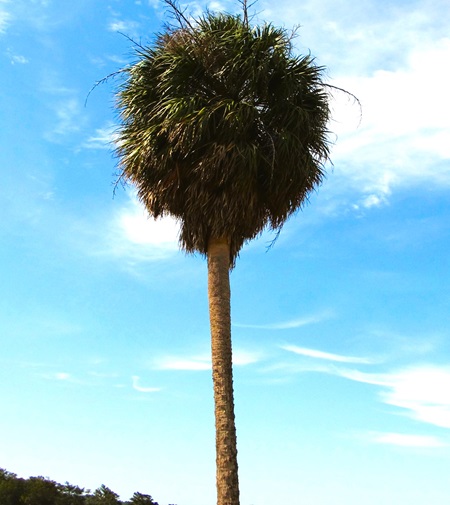 Some trunk boots are just visible.
Wildlife Value: It's a living ecosystem for Florida wildlife. It's earned a reputation among Native Americans as a "Tree of Life."
- The fruit is an important food for Florida black bears, white-tailed deer, raccoons, wild turkeys, and birds like northern bobwhites, cardinals, blue jays, scrub jays, and grackles.
- Black bears like dense palmetto thickets for their dens.
- The dead fronds hanging on become camouflaged roosting sites for yellow bats.
- The thick crown shelters varieties of birds, like hawks, owls, doves, hummingbirds, flycatchers, mockingbirds, and wrens. They all use Parts of the Palm for nest-building.
- Reptiles, snakes, lizards, and tree frogs also use the palmetto for shelter or nesting.
- Bees and other pollinators love the flowers. As does the Monk Skipper Butterfly (Asbolis capucinus) which deposits its larva there.
Landscape usage is valuable to Floridians. Some use it as a focus palm, others plant several for a grouping in odd numbers. It's easy to grow this palm from seed, into a deep container, and it transplants well.
Saw Palmetto (Serenoa repens)
Sometimes nicknamed the Silver Saw Palmetto.
- It has clustering trunks, meaning multiple side trunks sprout from the original. The first trunk grows underground, then for years stays low to the ground. If you can see the trunk, you'll find it's covered in fibrous leaf bases.
- Stiff palmate fronds come in several color forms: light or deep green, blue-green, and vividly silvery-blue.
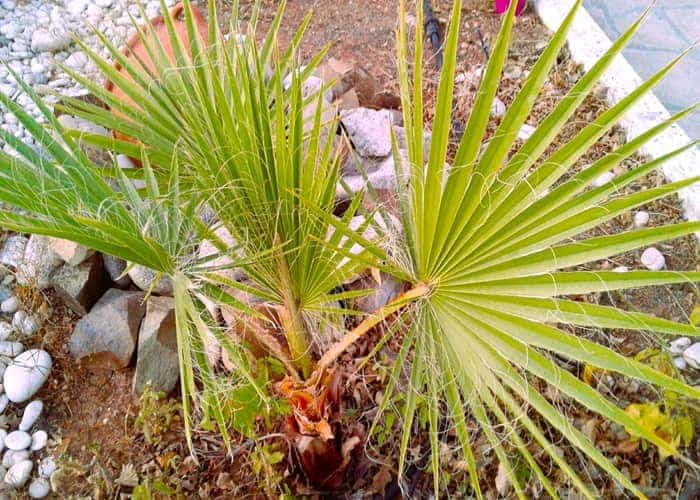 Notice the rigid fronds with fiber threads.
You can see them growing widely, spread out like ground cover in Florida coastal pinelands. Plus many inland habitats. Some plant them as a hedge border in their landscape.
This native Florida palm is also important to humans and animals.
- The flowers are prized for the honey. Beekeepers follow the blooming to move hives adjacent.
- Its dried fruit is used in medicines and herbal supplements throughout tropical areas world-wide.
- And similar to the Cabbage Palm, wildlife hides, raises young and eats the fruit.
Silver Palm (Coccothrinax argentata)
Quite durable, it's drought tolerant. Plus it calmly survives most pineland fires and it can grow from limestone ledges.
- You may first notice it's thin crown of about 16 widely spaced fan fronds. While dark green above, leaf undersides do have distinct shiny, silver coloring. The tips droop down.
- Its solitary trunk gets 35ft/10.5m tall.
- It's well adapted to sandy lands on Florida's southeast coast. Soil needs aren't fussy.
 Also known as the Dominican Silver Palm.
Paurotis Palm (Acoelorrhaphe wrightii)
Its primary territory is the Everglades in Florida. Tolerating the swampy, salty soil.
Identify It:
- Densely clustering medium sized trunks that hold onto leaf bases. For those looking for a privacy fence, this works.
- Another palmate, the partly round, dark green leaves are silvery beneath. The stems are armed with reddish brown hooked fibers.
With rare southern freezes, it's been known to seem dead, but then revives!
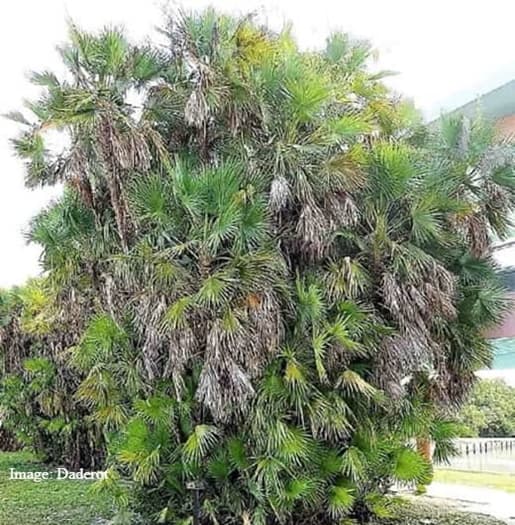 Commonly called the Everglades Palm, that's where this one is.
Florida Thatch Palm (Thrinax radiata)
Another Florida Keys native, it prefers sunny coastal areas.
It's a short, slow-growth, attractive landscape palm.
- The palmate fan fronds have dark green tops, silvery hues below.
- Solitary trunk slowly maxes out at 50ft/15m.
- The flower stalks (inflorescences) are yellowish making a nice contrast, even moreso with the white blooms.
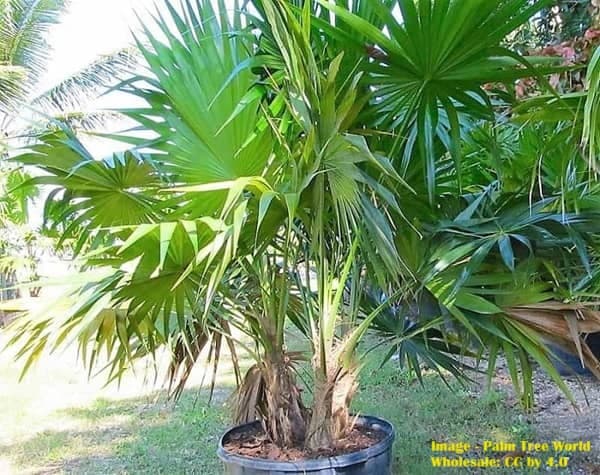 A potted Florida Thatch palm ready for planting.
Needle Palm (Rhapidophyllum hystrix)
Also nicknamed the Porcupine Palm. Possibly the most cold-tolerant palm in the world! So northern Florida is just fine.
- Quite short, only gets 12ft/4m tall, slowly.
- Narrow, very short clustering trunks look thick with masses of leaf bases.
- The palmate fronds are dark green above, silvery below.
Although adaptable, it's preferred environment is beneath taller trees of hardwood forests. With moist, humousy soil.
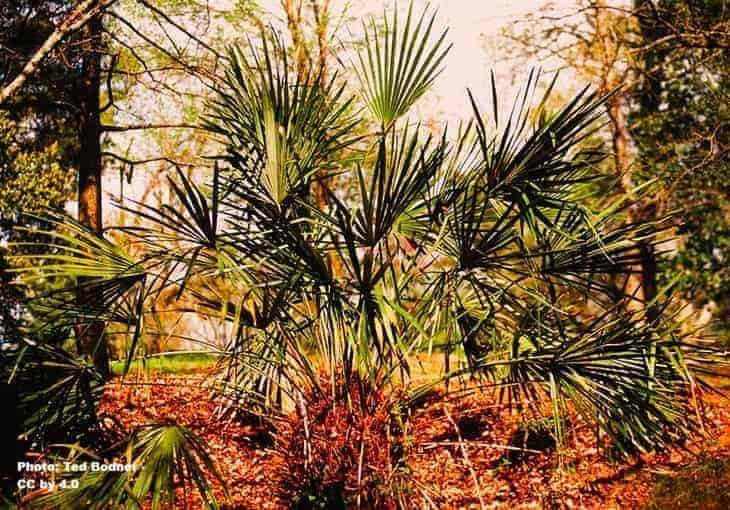 Per its common names, covered with unfriendly needle-like fibers.
Buccaneer Palm (Pseudophoenix sargentii)
Native to the Florida Keys, it's also called the Cherry Palm. Only documented in 1886 on Elliot Key. But then noted on Sands Key and Long Key.
Considered rare because of some circumstances:
- According to biologist (and International Palm Society member), Scott Zona who noted in 2002 that its slow, but easy growth has encouraged taking wild P.sargentii sprouts to plant in Florida yards.
- Yet not easily grown from seed.
- Thus its "Vulnerable" global conservation status.
To help ensure its survival, Fairchild Tropical Botanical Garden planted many specimens on Florida Key. See the Story of its Life Continuation.
 The Buccaneer Palm
Latest Updates


-
Where Are Palm Trees Native? Surprising to You?!
 Where are palm trees native? Were you wondering. Meaning where are they indigenous, endemic, or naturally originally from. You'll discover it!
Where Native Florida Palm Trees Grow
Different native palms occupy different environments, evolving to do well in their growing area. Those landscapes range from beaches and dunes to swamps and pine forests.
Understanding their natural habitat helps with identification, as well as landscape selection if you're planning to place a Florida native palm into your landscape.
Coastal Areas
Those are the beach areas well-known along Florida's coast. It also includes coastal hammocks, those stable sand dunes with dense hardwood forest. They're typically narrow areas, like barrier islands.
These environments have sandy soil. Salt spray will often be spritzed across these spots because of windy conditions.
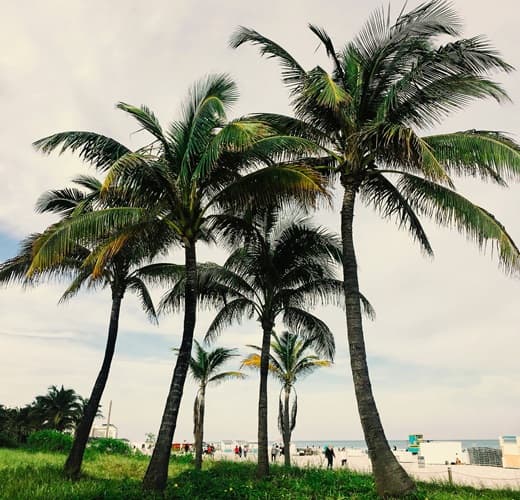 Palms Beachside
Florida native palms you'd find in coastal areas are the Silver Palm, Florida Thatch Palm and Buccaneer Palm. These are all very tolerant of the salt spray that sprinkles on them, adapting to it through eons. And they even prefer the sandy alkaline (increased pH) soils of these areas.
The cabbage palm is found in some coastal areas. Not as widespread as the others because they appreciate having some organics in the soil, and don't tolerate salt spray as well.
Wetlands and Marshes
Wetlands are moist land areas that flood with water seasonally, or always have areas of soggy soil.
For instance, the Everglades include wetlands:
- Sunny marshes with grasses and reeds
- Thick, shady swamps with shrubs and tree
The Florida native palms that excel in this environment are the the Paurotis Palm and the Cabbage Palm. Both tolerate flooding, having adapted over time to wet soil. Some salty spray won't harm these, but they don't like continuously salt breezes.
Wildlife love these bushy palms for the shelter they provide. As they grow thickly with multiple trunks.
Pine Flatwoods
The palms below enjoy growing in these flat areas, with sandy soil that's often dry, yet can hold onto moisture. They grow in open pine forests. Preferring these fire-adapted ecosystems, where pines depend on fire for ongoing survival.
The Saw Palmetto and Needle Palm do well in this environment. They both can withstand drought, with some fire resilience. They both have clustering trunks and a low to the ground. The Saw Palmetto grows widely throughout Florida, while the Needle palm is best in North Florida locations.
Tropical South Florida Habitats
Tropical habitats mean they almost never experience severe temperature dips.
This includes the hardwood hammocks of the Florida Keys and the Southern Everglades.
Four palms are restricted to these South Florida tropical environments: Silver Palm, Florida Thatch Palm, Buccaneer Palm and Paurotis Palm. Their Florida geographic range is limited to southernmost areas, which are the true tropics.
 It's considered a frost-free climate.
Native vs Non-Native Palm Trees in Florida
Visitors to Florida sometimes think if the palms they see are everywhere, then they must be native. At some point, they'll ask something like "I see lots of palm trees in Florida, but which ones are truly native?"
Many of the most recognizable palms actually originated in places other that the state of Florida. So it's true some palms are seen throughout the state, like the ever-present Coconut Palm. But many (probably most) you'll see were introduced because of their interest and beauty in a landscape.
The table below compares some native Florida palms with popular ornamental species that were introduced from other parts of the world.
| Palm Species | Native to Florida? | Origin | Common in Florida Landscapes? | Key Fact |
|---|---|---|---|---|
| Cabbage Palm (Sabal palmetto) | Yes | Florida and the southeastern United States | Yes | Florida's official state tree. |
| Saw Palmetto (Serenoa repens) | Yes | Southeastern United States | Yes | One of Florida's most widespread native plants. |
| Silver Palm (Coccothrinax argentata) | Yes | South Florida and the Florida Keys | Limited | Recognized by its striking silver leaf undersides. |
| Paurotis Palm (Acoelorrhaphe wrightii) | Yes | South Florida and the Caribbean region | Moderately Common | A clustering palm native to Everglades wetlands. |
| Queen Palm (Syagrus romanzoffiana) | No | South America | Yes | One of the most widely planted ornamental palms in Florida. |
| Foxtail Palm (Wodyetia bifurcata) | No | Australia | Yes | Popular for its distinctive foxtail-shaped fronds. |
| Coconut Palm (Cocos nucifera) | Generally No* | Tropical Indo-Pacific region | Yes | Long cultivated in Florida; native status is debated by some authorities. |
| Canary Island Date Palm (Phoenix canariensis) | No | Canary Islands | Yes | Large ornamental palm often planted as a specimen tree. |
*Note: Coconut palms have been present in Florida for centuries and are strongly associated with the state's tropical image. However, most botanical authorities do not consider them native to Florida because they originated elsewhere and were dispersed around the tropics by ocean currents and human activity.
Which Native Florida Palm Is Best for Landscaping?
Several native palms make excellent landscape plants while also supporting Florida's natural ecosystems. Those non-native palm trees planted must still be the right palm for the hot, subtropical climate in Florida.
If you're a Floridian, you may want to know about suitable palms for your own yard and conditions.
SMALL SPACES: You may find the one you'd like in our Article About Small Palms - just be sure it matches with your USDA climate tolerance zone. The Dwarf Palmetto (Sabal minor) may do well for you.
COASTAL LANDSCAPES: The Seashore Palm (Allagoptera arenaria) works well in sandy beach soil. Salt spray and wind don't bother it. This short palm with a mostly underground trunk is best in Zones 9-11.
WILDLIFE GARDENS: The Forida State Tree would be ideal. See More Details [use #Cabbage] about Sabal palmetto, the Cabbage Palm.
COLD-PRONE AREAS: For Florida, especially the northern part of the state, the Needle Palm should be excellent, growing in Zones 6b-11. Our Article About Cold-Hardy Palms offers you more ideas.
WET SOILS: The Australian Cabbage Palm (Livistona australis) doesn't mind soggy soil at all. Native to Australian Pacific coasts, sometimes in swampy areas. It tolerates salt a little. Best climate zones 9-11, warmer 8 microclimates are possible.
Why Native Palm Trees Matter
Native palms do more than beautify landscapes. They provide natural habitats and ecological benefits that introduced species often cannot match.
Wildlife Value: Long-time indigenous animals depend on palms native to Florida for food, protection and rearing their young. Pollinators can be picky for plants they visit. But native pollinators normally prefer native palms.
Conservation: Preserving species throughout the earth is always important. Native palms contribute naturally within their Florida biomes.
Drought Adaptation: Not all locations in Florida always get regular rainstorms. Plus rain on the sandy soils tends to filter through rapidly. Some natives are drought tolerant like the Saw Palmetto (Serenoa repens), and help fill a flora need.
Hurricane Resilience: Florida is known for getting hurricanes regularly. Native palms have evolved to survive these storms. Palm trunks can bend rather than break. And their leaves have another Useful Trait for Storm Survival. [use #wind at inside palm]
Key Facts About Palm Trees Native to Florida
These quick facts about Florida's native palms help you get the overall picture.
- Florida has the greatest diversity of native palms in the continental United States.
- The cabbage palm is Florida's state tree, as well as for South Carolina.
- Saw palmetto is among the state's most widespread native plants.
- Several native palms occur naturally only in South Florida and the Florida Keys.
Frequently Asked Questions About Native Florida Palm Trees
What is Florida's state palm tree?
What is Florida's state palm tree?
The cabbage palm (Sabal palmetto) is Florida's official state tree.
Is the queen palm native to Florida?
Is the queen palm native to Florida?
No. Queen palms originated in South America and were introduced into Florida landscapes. Florida residents desired it because of their beautiful tropical appeal.
What is the most common native palm tree in Florida?
What is the most common native palm tree in Florida?
The Saw Palmetto and Cabbage Palm are generally considered the most widespread native palms for Florida.
Are royal palms native to Florida?
Are royal palms native to Florida?
The Short Answer: Yes - but it's complicated!
And some debate it because of their history in Florida.
The Royal Palms growing wild in Florida are the same species as the royal palms of Cuba (Roystonea regia). Written records place them growing naturally in Florida as far back as the 1700s. Today, wild populations are found in Collier and Miami-Dade counties in South Florida.
What makes the story interesting is that Royal Palms once grew much farther north than they do today. Scientists believe hard freezes, land clearing by early settlers, and heavy harvesting of palm wood likely pushed them out of central and northern Florida over time.
Palm scientist Scott Zona, who has studied the species extensively, confirms Florida's populations as genuinely native, not the result of planting or accidental spread.
Which native Florida palm is the most cold hardy?
Which native Florida palm is the most cold hardy?
The Needle palm is generally considered the most cold-hardy native palm found in Florida. Or most other places for that matter!
University of Florida Institute of Food and Agricultural Sciences Florida Native Plant Society Florida Department of Environmental Protection
More Palm Interest
Landscaping Around a Palm Tree that Looks Polished
Landscaping around a palm tree is easier with layered plants, edging, color, and climate-smart ideas that make one standout palm feel finished.
Where Are Palm Trees Native? Surprising to You?!
Where are palm trees native? Were you wondering. Meaning where are they indigenous, endemic, or naturally originally from. You'll discover it!
Landscaping With Palm Trees - Ideas & Top Tips!
Transform your yard when you discover our easy landscaping with palm trees ideas, perfect for any skill level. See simple designs that make a big impact.


About the Authors: Karen McGowan is the creator of MissionPalmTrees.com, and The Palm Species Navigator, along with her husband Bill. Where they share easy to read palm tree expertise gained from years of finding and studying palms in varied climates. So readers will know palms, and can avoid costly palm planting mistakes. Learn more.
We Love Arizona Where Palm Trees Grow & We Love Helping Others Appreciate Them Too!
Member of Local First Arizona - Supporting Local Businesses Wherever They Are!
Privacy Policy> | Terms/Conditions/CC Licenses> | Advertising Disclosure> | Contact Us>
Copyright © 2022 - MissionPalmTrees.com All Rights Reserved

Do Not Copy - No use is permitted without permission. Scraping the contents of MissionPalmTrees.com website for the purpose of AI (artificial intelligence) LLM (large language model) training is strictly forbidden. Mission: Palm Trees Name & Logo Registered in the U.S. State of Arizona
As an Amazon Affiliate we earn from qualifying purchases.
A Production of Picture Rocks Networking LLC
This site is protected under U.S. and International copyright laws.