- Home
- Where Palms Grow
- How to use USDA
USDA Zones for Palms | How to Use Them the Right Way
Before you fall in love with a palm, make sure it can make it through your winters.
USDA hardiness zones are the quickest way to check. Each zone is based on coldest winter temperature averages where you live, so a palm's zone rating tells you how cold a winter it's expected to survive.
A zone rating alone doesn't mean a palm will do well for years. A palm rated for your zone can still struggle if your microclimate won't suit the palm.
We'll show you how to use USDA zones the best way for your palms. Like the same quick check we use before writing about any palm: like first - what planting zone does it match? Then we'll show you the next steps: checking exposure, how long cold spells last and your local winter conditions.
That way you can choose a palm that won't just survive one winter but will still be growing strong for years.
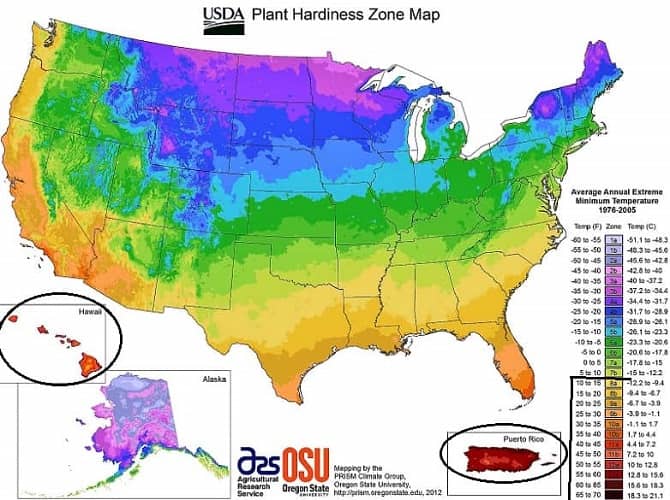 Pointing out where most palms grow.
Feeling overwhelmed by palm tree problems or confusing information?
You’re not alone! At Mission: Palm Trees, we do the Authentic Research for you, by cross-checking botanical data, and then making palm tree info interesting, easy to read & more fun to know.
How USDA Zones Help You Rule Palms In or Out
USDA Zones are the first filter that helps you narrow realistic palm choices before buying or planting a palm you'd love to have.
Start With Finding Out Your Zone Using Your ZIP Code.
Write down your full zone, including the letter, like 8a or 9b. Don't just write "zone 8." Because your zone is the yardstick for every palm you look at. Each full zone covers 10°F/5.56°C, and each "a" or "b" half covers 5°F/2.8°C.
With the sensitivity palms have, those 5F/2.8C degree ranges can decide whether a palm makes it through the winter. So before you look at how tall a palm grows or how fast it grows, you want to know this: can it handle your winters?
That takes three quick steps and a follow-up.
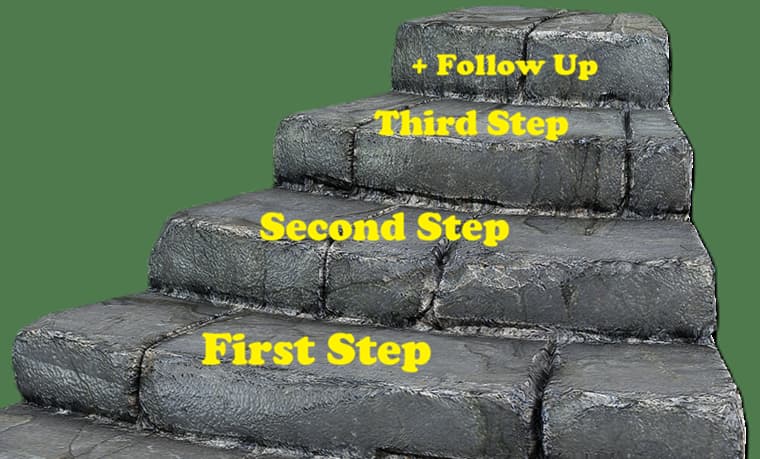
Start With Your Zone, Then the Palm’s Minimum Zone
Step 1: Find your exact zone number/letter using your zip code.
Step 2: Find the palm's minimum zone.
Then think of the palm you're considering. In the store or nursery, palm labels might give you a range, like "Zones 8–11." And Palm Guide Books certainly will let you know that.
The lowest number is the palm's minimum zone. It's the coldest zone where the palm is expected to survive. The minimum zone is the number that tells you about cold.
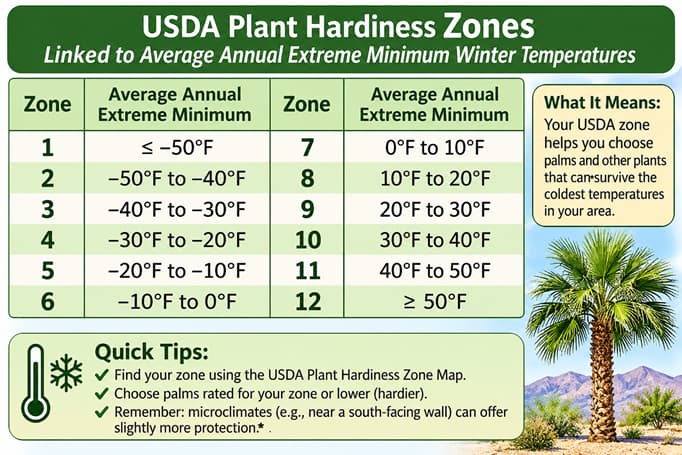 USDA Plant Hardiness Zones are based on the average annual extreme minimum winter temperature over a 30-year period. Each full-number zone spans 10°F. What's important is the lower number.
The top of the range is more about whether the palm can handle heat, but it's not very important in many climates. You won't use it to judge winter survival.
Tip: Check more than one trusted source, because they don't always agree.
- For the Windmill Palm (Trachycarpus fortunei), the Missouri Botanical Garden says it's winter hardy to Zone 7.
- While UF/IFAS lists it as hardy in Zones 8A–11.
- When sources disagree, go with the higher, more cautious zone's number.
Step 3: Compare the two numbers of your zone to the palm's required zone.
- If the palm's lower zone is the same as your zone or higher, it passes this check. Keep it on your list.
- If the palm's lowest zone is lower than your zone, rule it out.
- The only exception is if you decide to try "zone pushing" and are ready to protect the palm or replace it.
Example: Riffle's Timber Press Guide Book to Palms says the Queen Palm (Syagrus romanzoffiana) is suited to Zone 9b, where winter lows stay above 25°F/-3.9°C. If you're in Zone 9a, your average coldest night is 20-25°F/-6.7°C to -3.9°C. That's colder than the queen palm is rated for, so it doesn't pass.
Checking the zones first works because it saves you time and money. It eliminates palms that are almost sure to fail where you live.
Treat a Close Match as Caution, not Confidence
Borderline palms are the ones where the next check matters most. Treat that result as a "maybe."
If your zone is right at the palm's limit, or if trusted sources disagree by one half-zone, mark the palm as borderline as it won't be a sure thing.
- A Cat Palm (Chamaedorea cataractarum) in Zone 10a is a good example: one source says yes (Riffle), another says no (Meerow).
- And the Silver Palm (Cocothrinax argentata), according to Riffle, is marginal in 9b minimum. While Meerow says it's for 10b-11.
What a Palm’s USDA Zone Rating Actually Means
So exactly what are these zones rating? How do they figure it out?
USDA Zone Maps Over Time
The current map seen above came out in 2023.
- Over past 30 years they looked at the coldest winter temperature averages. The current USDA map uses weather data between 1991 and 2020.
- The zone map is broken up into districts of the United States and its territories. Depending on where each area fell within their 13 zones of temperature averages.
When they looked at the range of temperatures from 1991-2020, they found their prior map needed updating. Because there is now much more weather station coverage for temperatures, resulting in about half the U.S. needing placement into a warmer zone, since temperature ranges were higher than on the prior map.
That's also something to consider related to your sources for a palm's hardiness zone. If the copyright date is earlier than 2023, they're using an earlier map.
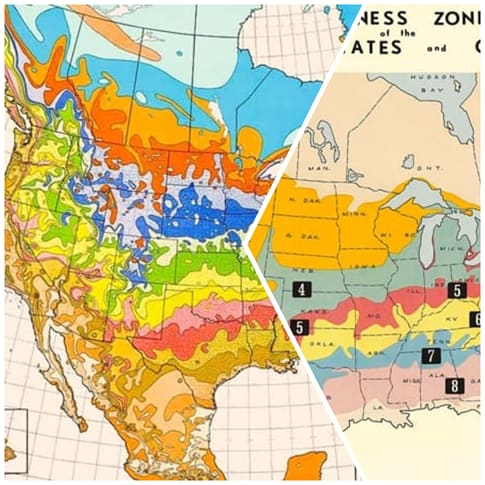 Earlier zone map versions.
A Zone Rating is About Cold Survival, Not Overall Performance
As the USDA map’s climatologist explained, it has nothing about when to plant, how long your growing season is, or how hot your summers are.
- A plant may survive your winter but still fail because of summer humidity or drought.
- Soil, rainfall, and microclimate also decide how a palm performs.
- More extreme winters can still occur.
- Individual zones can be hit with an unusual freezing spell.
A palm rated for your zone is meant to be a good starting point for temperatures, not a promise. The zone details still need follow up with all the palm's requirements before you buy or plant.
Most palms are true tropical plants. Many are fatally affected at 20°F/-6.7°C while the cold-hardiest are not killed at 29–30°F (-1.7° to -1.1°C). You see that one single zone can divide between life and death.
Other influences that matter are heat, nearby structures, soil drainage, wet winter weather, local frost pockets, wind exposure and rainfall. Which, of course, the maps won't help with.
What USDA Zones Do Not Tell You About Palms
Winter Duration, Wet Cold, Wind, and Exposure Still Matter
Some areas are known for cold winters, with wet snow and windy days. But can a palm withstand all that?
A USDA hardiness zone says nothing about summer heat, humidity, or soil. A palm that survives your coldest night can still struggle in another climate where the zone may seem to suit it.
These averages also hide the rare extreme killing freeze, which can happen.
For instance one Florida expert grower described a 22°F (-5.6°C) night that might not reoccur for 50 years, or yet might come during any winter. He also noted that the map ignores how long and how often cold lasts.
Treat your zone as a starting point. Check each species' tolerance for low extremes, duration of cold, and local climate before you plant. Use this other page for species lists and Palm Options for Colder Climates, as this page only shows how to interpret zones.
Once you've completed The 4-Steps Above, spend your time checking your property's exposure, how long cold spells last and local winter conditions. Add that comparison for determining if your chosen palm will have a real chance.
Surviving a Cold Event is Not the Same as Prospering Long Term
A palm may survive a short dip into temperatures it's not suited for by its USDA zone.
It may have immediately survived - but is there damage that will badly affect it in time. For instance, microbes can invade soft spots on the trunk caused by the freeze, leading to secondary problems.
According to Broschat, cold damage can show up several months to as long as several years after the freeze event. In these instances, it was suffering and deteriorating behind the scenes.
 The fungal damage from a freeze is finally showing up.
How to Judge a Palm More Accurately Than the Label Alone
Here is a practical decision framework using zone minimum, lowest temperature tolerance, and site conditions.
Before You Buy, check three things about your wanted palm together.
1) Does the zone fit?
Compare your USDA zone minimum with the palm’s rated hardiness. A rating well above your zone’s coldest is a good sign. A close match means you need the next two checks. Use the palm’s minimum zone and lowest tolerated temperature together.
2) Can it handle your kind of winter?
A hardiness rating is an entrance point, not a guarantee. UF/IFAS points out a palm’s degree of cold acclimation predicts damage better than the absolute low temperature.
- A palm that cools gradually over weeks, with winter temperatures gradually dropping, may show no injury until the low-to-mid 30s°F, or the low single digits celcius.
- Climate type matters too - such as more humid vs arid cold. Two locations can share a zone and still suit different palms.

3) Does your property's site intend to help or hurt your palm?
Nearby tree canopies or structures such as buildings and solid walls create microclimates within one landscape. Do this to hold back the hurt:
- Avoid low spots where cold air settles.
- Check your soil. Poorly drained soil leads to weak, extra-shallow roots that are more vulnerable to cold.
- Shelter from winter's prevalent cold winds also helps.
Look for a Safety Margin, Not a Perfect Edge-Case Match
The Rule of Thumb:
If the zone and the palm’s tolerance leave little leeway, plant only where your site gives you protection.
And prepare to have protective covers as a backup. Palms can use "winter coats" to protect against frost more than against extreme cold.
See Our Latest


-
USDA Zones for Palms: How to Use Them the Right Way
 Learn how to use USDA hardiness zones to choose the right palm tree. Understand what zone ratings mean, what they do not tell you, and how to ensure winter survival.
How Microclimate Changes the Answer
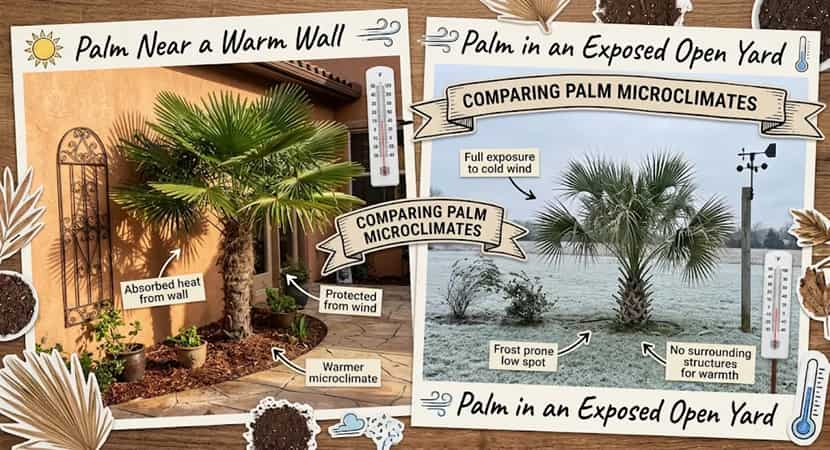
Some Localized Conditions Create a Microclimate. If two gardens or different spots on your property are in the same USDA zone, each area can provide a totally different experience for your palms.
Different experiences with different results for the same palm. Like...
- in a windy, exposed spot.
- if a cold snap lasts for days instead of hours.
- if you have wet cold winter days with frost or ice.
Warm Walls, Urban Heat, and Protected Spots
Some spots stay a bit warmer on cold nights.
A house absorbs heat during the day and releases it at night. A south-facing wall (in the Northern Hemisphere (north-facing south of the equator) absorbs and expels extra heat.
Cities do something similar on a larger scale. In the U.S., urban nighttime temperatures run about 2-5°F (1–3°C) warmer than outlying areas. Because hard surfaces like roads, rooftops, and large buildings absorb and shed more heat than natural grounds.
Shelter helps too. Tree canopies can reduce cold injury during frosty clear, calm nights. Fences, dense shrubs, and buildings may help protect young palms.
These effects are a few degrees of help, not a guarantee.
Open Exposure, Frost Pockets, and Cold Wind
Exposed and low spots lose the most warmth.
On clear, calm nights, leaf surfaces can fall to 32°F/0°F or below even though the air is several degrees warmer. An open meadowy site or wide lawn expanse makes this worse.
Tender palms shouldn’t be placed in lower areas, because cold air settles there. Cold air flows downhill from higher ground and pools on valley floors. For instance where we live in Tucson Arizona, cold air flows down to the city from the mountains in dry stream beds (locally called washes).
Wind adds its own damage.
- In a wind-driven hard freeze, all exposed plant parts cool down uniformly.
- Dry wind and sun can also pull more water from leaves than chilled roots can replace.
Fences, buildings, and neighboring plantings can slow these winter winds, depending on their height, density, and location.
Common Mistakes People Make With USDA Zones for Palms
Let's reinforce what to do to avoid the common errors people make.
The common thread is that a zone tells you whether a palm might survive. It doesn't tell you whether the palm will excel for decades in your yard.
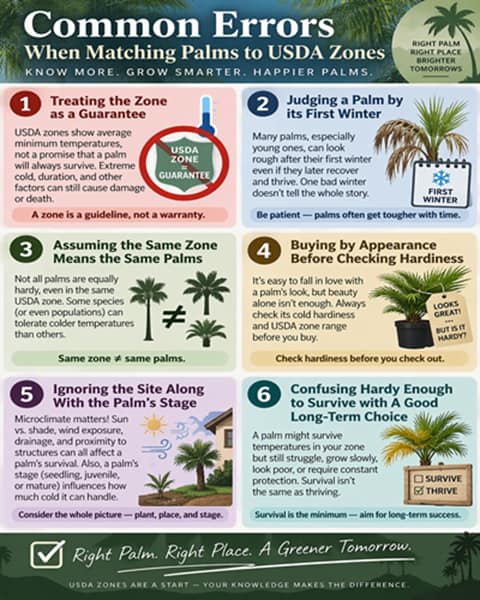
Treating the Zone as a Guarantee
A common assumption is that a matching zone number is probably enough by itself. But you need more than that as a palm that fits your zone can still be lost in a rare cold event.
Judging a Palm by its First Winter
Trunk rot from cold damage can appear months after a freeze. Palms often live at least two years before the problem shows.
Be wary, as a palm that looks fine in spring hasn't yet proven it's a long-term fit.
Assuming the Same Zone Means the Same Palms
Palms can struggle in humid, wet Florida even though matching California's cool and dry winter low zone temperatures. Climate type matters as well as the number.
Buying by Appearance Before Checking Hardiness
Some don't worry about the zone limit, instead going past it because of the wonderful looks of a palm they love.
UF/IFAS says homeowners often want a tropical appearance by planting a palm. Resulting in betting against average winters. Though it might pay off if you plan for protection.
Ignoring the Site Along With the Palm's Stage
Recently planted, or unestablished palms are more vulnerable to cold injury. A young palm in an open or low spot faces far more risk than a mature palm near a sheltered wall.
Confusing Hardy Enough to Survive with A Good Long-Term Choice
Watching only for freezing won't work. Chilling injury can hit tropical palms above freezing, occasionally as high as 50°F/10°C. So if a palm is on the tender side, a cold night above 32°F/0°C can still hurt it.
REFERENCES:
Daly C, Widrlechner MP, Halbleib MD, Smith JI & Gibson WP (2012). Development of a new USDA plant hardiness zone map for the United States. Journal of Applied Meteorology and Climatology 51(2): 242-264. doi:10.1175/2010JAMC2536.1
Smith (1986). Principes 30(1); USDA/PRISM map documentation.
USDA Plant Hardiness Zone Map (2023). Map Creation. Agricultural Research Service, U.S. Department of Agriculture. From planthardiness.ars.usda.gov/
Broschat TK (2021, Sept 14). Cold Damage on Palms. DOI: 10.32473/edis-mg318-2010
Riffle, RL (2008). Timber Press Pocket Guide to Palms. OR: Portland.
Meerow AW (2002). Betrock's Guide to Landscape Palms. Eighth edition, Betrock Information Systems. FL: Hollywood.
Broschat TK, Meerow AW & Elliott ML. (2017) Ornamental Palm Horticulture. Second edition, University Press of Florida, Gainesville.
FAQs - USDA Zones for Palms
Can palms grow outside their listed USDA zone?
Can palms grow outside their listed USDA zone?
Yes, it does happen. We've even seen one in Minnesota!
Especially within a half or full zone of a palm's rating. Because USDA zones only give you averages of past years of winter's lowest temperatures. Our Article Here shows how they do this. If you're willing to risk it, you could try pushing a palm's limits like this:
- By planting in warmer microclimates, like near a southern or western brick wall, under a dense tree canopy, or away from low areas gathering pockets of frost.
- By keeping a steady watch on weather reports when winter or cold weather begins, so you're ready to Give Winter Protection when below freezing temps are predicted.
- Know your palm's low temperature limits, and see how far you really want to push that.
But the best thing to do is Plant Cold-Hardy Palms.
Keep in mind that zone-pushing is a definite gamble. An unusually severe freeze can come along and seriously damage a palm, and it may end up a fatality. Do you really want to risk that?
Is the lowest temperature more useful than the zone number?
Is the lowest temperature more useful than the zone number?
For the clearest view, use both together, like We Demonstrate Here in this article.
Your USDA zone number is the first filter because it uses a narrows temperatures into a 5°F half-zone window. The USDA uses recent 30-year average of winter's lowest temperatures. A species' lowest tolerated temperature tells you what to expect with a cold snap. Check both while still considering the length of your own typical cold spells, and whether winters are usually wet or dry.
Yet, the USDA focus is on zones for the United States. People in other countries can use the USDA zones by researching the lowest temperatures their area experiences. Then reference the specific palm's lowest zone range to see what to expect for that palm.
Why do two sources give different hardiness ratings for the same palm?
Why do two sources give different hardiness ratings for the same palm?
Different sources may be using different USDA map versions, regional climates, and other testing criteria.
Some Palm Guide Books still reference pre-2023 zone maps. Some use other factors like humid or wet winters comparied to arid. Or show how a palm has documentation for surviving a single overnight freeze.
When trusted sources disagree, it's safest to follow the higher, more cautious zone number. See More Here>
Takeaways for using USDA Zones for Palms
We took you through the steps to see what USDA Zones for palms can do for you. Now if you're looking for related information, we have these articles that will help you out.
Where Palms Can Grow - Use this page for a broader geography and climate-range overview beyond USDA-zone mechanics.
Winter Palm Protection - Use this page for what to do when a palm is borderline or needs protection in cold periods.
Palm Freeze Damage Symptoms - Use this page for diagnosing what happened after cold injury if you already have a palm planted that wasn't preventing the mistake at selection stage.

About the Authors: Karen McGowan is the creator of MissionPalmTrees.com, and The Palm Species Navigator, along with her husband Bill. Where they share easy to read palm tree expertise gained from years of finding and studying palms in varied climates. So readers will know palms, and can avoid costly palm planting mistakes. Learn more.
More to See...
Landscaping Around a Palm Tree: Best Plant Ideas
Choose companion plants, edging, and mulch that make your palm tree stand out, with landscaping around a palm tree ideas that protects the trunk.
Where Do Palm Trees Grow? World Climate Guide
See where palm trees grow across tropical, subtropical, desert, and temperate climates, with examples from the U.S. and around the world today.
Landscaping With Palm Trees - Ideas & Top Tips!
Transform your yard when you discover our easy landscaping with palm trees ideas, perfect for any skill level. See simple designs that make a big impact.

Don't Miss It: The Right Palm, The Right Place
Our free quick-reference guide is yours! So you can stop guessing which species will survive your local climate.
Along with that, the Palm Species Navigator for tips on species hardiness, seasonal care, and more. Click to enter your email & get your guide.
We Love Arizona Where Palm Trees Grow & We Love Helping Others Appreciate Them Too!
Member of Local First Arizona - Supporting Local Businesses Wherever They Are!
Privacy Policy> | Terms/Conditions/CC Licenses> | Advertising Disclosure> | Contact Us>
Copyright © 2022 - MissionPalmTrees.com All Rights Reserved

Do Not Copy - No use is permitted without permission. Scraping the contents of MissionPalmTrees.com website for the purpose of AI (artificial intelligence) LLM (large language model) training is strictly forbidden. Mission: Palm Trees Name & Logo Registered in the U.S. State of Arizona
As an Amazon Affiliate we earn from qualifying purchases.
A Production of Picture Rocks Networking LLC
This site is protected under U.S. and International copyright laws.