- Home
- Palm Problems
- Are Palms Poisonous
Are Palms Poisonous? What People and Pet Owners Should Know
Walk through plant nurseries or palm gardens and you will see people bringing along their dogs and kids. Newbie gardeners will also be there studying palms they'd like to have. So is there any danger there? Are palms poisonous?
Essentially the answer is no. Palm trees are not poisonous. Except for one, that you're not likely to eat.
True palms, Arecaceae family members, are safe landscape plants. But there are a few exceptions: two palm possibilities, one imposter, and an injury risk that can be harmful.
We'll cover each of those.
Feeling overwhelmed by palm tree problems or confusing information?
You’re not alone! At Mission: Palm Trees, we do the Authentic Research for you, by cross-checking botanical data, and then making palm tree info interesting, easy to read & more fun to know.
Are Palm Trees Poisonous to Humans?
The answer to that question is very close to no! As nearly all palms are not poisonous to humans.
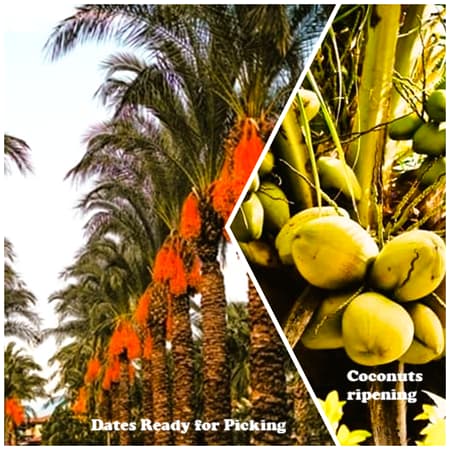
Think about the fruit from Date Palms and Coconut Palms. Every day people around the world are munching on them! Even palms you're likely to see in home landscaping aren't poisonous.
The caution we'll give you is short and specific. Because there are some allowances to be made.
- Only one palm species contains a true poison - arsenic.
- Another is rumored to be poisonous, but that's never been confirmed or documented for accuracy.
- Some other Palm Fruits contain an irritant called calcium oxalate crystals. It's not a true poison, yet be aware of how it affects people and animals.
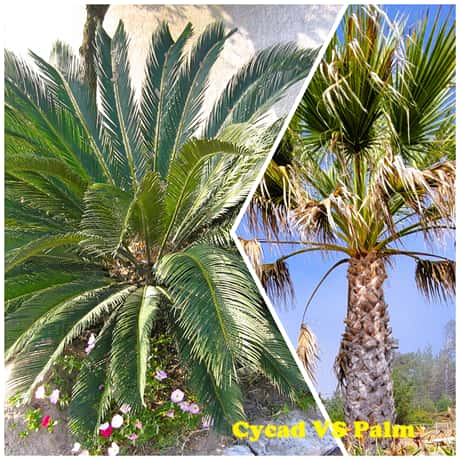
The ones that can cause confusion are only labeled "palms." For instance, the sago palm isn't a palm at all - it's a cycad. It does have strong toxicity from its seeds, but also other parts.
Be aware when you see "palm" on a nursery's plant tag. They tag them with that nickname, often without noting its botanically scientific name. The main guarantee for realizing a plant is a palm is that scientifc name.
Are Palm Trees Poisonous to Dogs and Cats?
No, palms you'll see are not poisonous. Because it's the cycads which are are ancient seed plants, and other palm "imitators" that have a truly poisonous ingredient called cycasin. It contains carcinogenic and neurotoxic properties.
If a dog or cat sniffs around a cycad seed cone, thinks it looks delicious - and then chews on the seeds - it's an immediate concern. Some of the effects, from bad to the worst, are drooling, vomiting, having diarrhea, liver damage and/or neurological problems.
If you know your pet dog or cat has been around a Sago Palm, or other cycads, and you see symptoms, it's an emergency! Get on the phone to your veterinarian right away.
At a minimum contact a pet poison hotline
Like the ASPCA 24-hour hotline at 888-426-4435.
 A puppy who didn't know better visits the emergency vet.
So be aware of Cycads like Cycas revoluta (Sago Palm) and Similar Palm Look-Alikes. All parts of cycad plants are toxic, and the seeds are the worst.
Actually, if a plant is called non-toxic, that doesn't mean it's okay as a pet snack. An animal that likes munching on any plant has the possibility of ending up with an upset stomach.
Which Palm Trees Are Poisonous?
Among true palms, the list of problem species is very short.
POISONOUS
I contacted the botanist and palm specialist, Scott Zona of NCSU (also a member of the International Palm Society where we met him), for information about any toxicity in palms. He gave me this information...
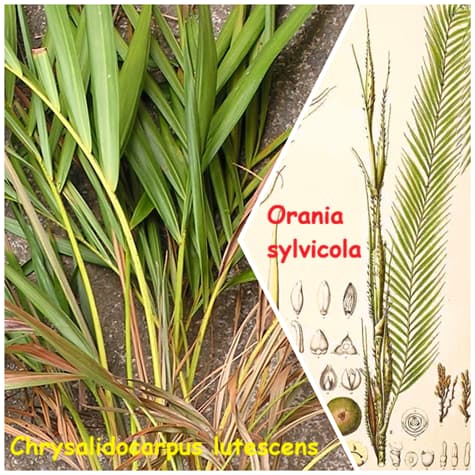
- Chrysalidocarpus lutescens (formerly Dypis lutescens) has cyanogenic (cyanide-producing) properties in its meristem (the heart of the palm - the growing point). Some people eat a few palm species hearts, but not this one!
- He also referenced an old report that a single fruit of Orania sylvicola could kill an elephant. To this day, that report hasn't been verified, plus if a toxin is involved with this fruit, the type is unknown.
IRRITANT
However, the fruit of some palm species contain calcium oxalate crystals. These microscopic shards take various shapes, but in palms are usually needle-like. They irritate soft tissues in the mouth, throat and esophagus.
- They can also cause contact dermatitis rash (if handling fruit, Broschat says wear rubber gloves).
- NC State Extension advises keeping children and pets away from these fruits.
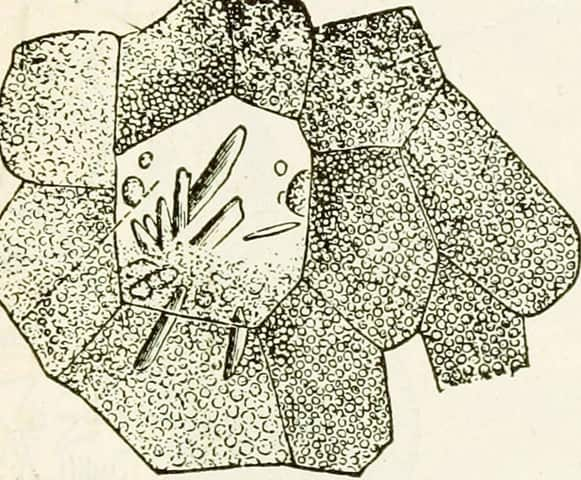 Diagram of needle-like calcium oxalate crystals within the plant's cells.
Different palm species fruit contain this oxalate irritant, in varying amounts.
- Those with the most oxalate-causing symptoms are: Ptychosperma waitianum, Chamaedorea costaricana & C.seifrizii & C.tepejilote, Arnga tremula, Hyophorbe verschafeltii, Dictosperma album and Roystonea regia.
- Those with half the amount compared to (i) above causes symptoms in sensitive people. If that's you, beware of Chamaedorea microspadix & C.cataractum, Gaussia maya, Carpentaria acuminata, Caryota mitis, Ptychosperma macarthurii, Pseudophoenix sargentii, Pinanga kuhlii, Leucothrinax morrissii, Chamaerops humilis and Calyptrocalyx holrungii.
- Others with even lower levels still may cause reactions in extra sensitive people. Some of those you'd most likely encounter are: Veitcha arecina (Montgomery/Sunshine Palm), Archontophoenix alexandrae (Alexandra King Palm), Thrinax radiata (Florida Thatch Palm), Syagrus schizophylla (Arikbury palm) & S.romanzoffiana (Queen Palm), Adonidia merrillii (Christmas palm), Serenoa repens (Saw palmetto), Sabal palmetto (Cabbage palm), Livistona chinensis (Chinese Fan Palm), Chrysalidocarpus lutescens (Dypsis lutescens, Areca or Golden Cane Palm), Phoenix canariensis (Canary Island Palm) and Bismarckia nobilis (Bismark Palm).
Among The Palm Look-Alikes, the Sago Palm (Cycas revoluta) and other cycads are the ones to treat as truly poisonous, not palms.
Are Palm Seeds and Fruits Poisonous?
On the whole, the answer is they're Not Poisonous.
Like those edible palm fruits, dates and coconuts, which are food crops. Most palm fruits are simply fruits with seeds for species continuation, and don't contain poison.
Instead it's the oxalate-containing Fruit Pulp Described Above, which irritates skin and mouths rather than poisoning the whole body.
Cyanide is also a worry when people talk about toxic seeds, and cyanogenic compounds do turn up in plenty of seeds around the world, but NOT IN NEARLY ALL PALMS.
The best-documented palm-like example belongs to cycads.
- A study of Taiwanese patients who ate cycad seeds found their blood cyanide levels were higher than normal but not in the toxic range.
- Severe vomiting was the main symptom.
- All patients recovered within 24 hours. Again, that's a cycad, not a palm tree.
Are Palm Fronds Poisonous?
Fronds from true palms are not poisonous.
Instead what can be harmful is anatomic: pointy, prickly spines on some Palm Species...
- At leaf bases
- On the tips of leaflets
- Along the palm stem or trunk.
We'll tell you more about that next...
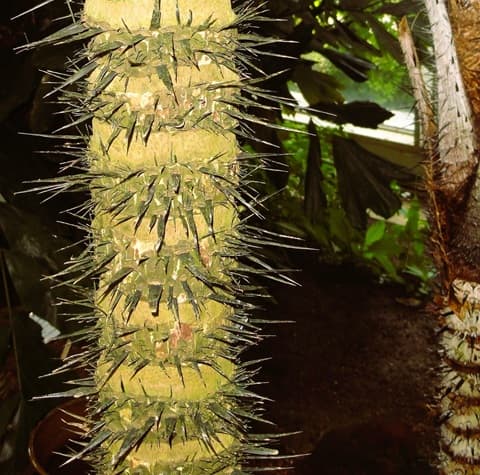 Be careful around a spiny palm trunk like this one!
What Happens If You Get Poked by a Palm Tree?
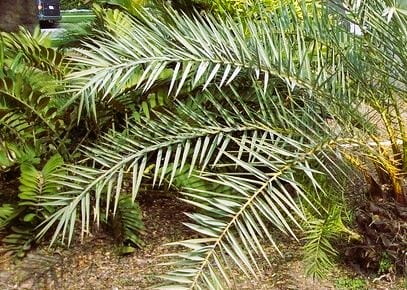 Pointy leaflet tips on a date palm.
One important distinction: poisonous and physically dangerous aren't necessarily the same thing. And this is where armed palms (palms with spiky points) can genuinely hurt people.
For example, a palm can have sharp spines that puncture skin without being poisonous. But a puncture from one can cause bleeding.
For example, the Date palm's (Phoenix dactylifera) lowest leaflets end in stiff thorny points.
The danger with any palm thorns is because they're long and sharp they can break off under the skin. That type of palm injury can bring on tissue inflammation, synovitis (joint inflammation), and sometimes infection. The Pantoea agglomerans Bacteria has been reported in infected thorn wounds.
TWO DETAILS MATTER:
- Palm thorns don't show up on X-rays.
- Symptoms can appear days or weeks later, and the victim has likely forgotten the poke.
IF YOU ARE POKED:
- Wash the wound well and remove any visible piece of thorn.
- See a doctor if it's a deep puncture, a joint area is involved, or swelling, pain and/or redness develops
- Ask about your tetanus status - When Was Your Last Tetanus Vaccine?
- When working with palms - Sturdy Gloves, long sleeves and eye protection are cheap preventative assurances.
REFERENCES
ASPCA (n.d.) Toxic and non-toxic plants: areca palm; parlor palm. aspca.org.
Broschat TK (2014) Roystonea regia: Royal Palm. ENH-732, UF/IFAS Extension.
Badran S, Mohammed M, Wani I, Hammouda A, Al-Lahham S. (2021, Feb 10). Date Palm Thorn Injury: A Literature Review and a Case Study of Extensive Hand Haematoma. Cureus;13(2):e13252. doi: 10.7759/cureus.13252. PMID: 33717759; PMCID: PMC7953174.
Kratz A, et al. (2003). Pantoea agglomerans as a cause of septic arthritis after palm tree thorn injury, Archives of Disease in Childhood, 88:542–544.
NC State Extension (n.d.) Caryota mitis, Plant Toolbox.
University of Vermont (n.d.) King sago palm: toxicity.
Chang SS, Chan YL, Wu ML, Deng JF, Chiu T, Chen JC, Wang FL, Tseng CP (2004). Acute Cycas seed poisoning in Taiwan. J Toxicol Clin Toxicol;42(1):49-54. doi: 10.1081/clt-120028744. PMID: 15083936.
Laqueur GL & Spatz M (1968, Nov). "Toxicology of Cycasin". Cancer Research. 28 (11): 2262–2267. PMID 4881504.
"Urine Crystals". ahdc.vet.cornell.edu/. Cornell University. Archived from the original on 26 June 2010. Retrieved by Wikipedia 12 July 2014.
Dransfield J, Uhl NW, Asmussen CB, Baker WJ, Harley MM & Lewis CE (2008). Genera Palmarum: the evolution and classification of palms. Royal Botanic Gardens, Kew. Sourced from Palmpedia, at palmpedia.net/wiki/Orania_sylvicola
Are Palms Poisonous? The Frequently Asked Questions
Which palm trees are poisonous to humans?
Which palm trees are poisonous to humans?
There are none you're likely to encounter.
For true palms of the Arecaceae family, there is one with cyanide, and another perhaps likely that hasn't been confirmed. See More About This Here>
The most confusion comes from nurseries nicknaming cycads as palms - for instance the King Sago Palm. A totally different family. See How These Cycad Plants May Act.
What happens if you get poked by a palm tree thorn?
What happens if you get poked by a palm tree thorn?
A stabbing from an armed palm with thorns can cause bleeding and be painful.
But a further complication may follow, like inflammation, and infection. Our article's Section Here Discusses the Details and What to Do.
Are palm leaves poisonous?
Are palm leaves poisonous?
No, palm leaves are not poisonous.
But some Parts of Fronds can cause you injury because they're armed with sharp projections. We Have a Concise Description that Explains Here - as it doesn't take much to clear this up.
But when you dive deeper, there are many more palms that can cause irritation to the throat when swallowed, as well as skin rashes.
Are palms poisonous to animals like our pets or for people?
Are palms poisonous to animals like our pets or for people?
No, any palm you're likely to see is not at all poisonous to pets or people.
Because of all the many palm species there is only one confirmed palm with seeds containing cyanide. That's the Chrysalidocarpus lutescens (formerly Dypis lutescens).
But still, See Why It's Not Worrisome.
Takeaways for Are Palms Poisonous
People become misled because cycads and some other plant species are often nicknamed as "Palms."
Almost every Arecaceae family palm isn't poisonous to people, dogs or cats.
- But watch for irritants some palms have: oxalate-containing fruit.
- And respect spines on date palms and others by using precautions.
- Remember that sago palms are cycads, not palms, and they're the ones to keep away from children and pets.
- When in doubt, identify the plant by its scientific name, not its common name.

About the Authors: Karen McGowan is the creator of MissionPalmTrees.com, and The Palm Species Navigator, along with her husband Bill. Where they share easy to read palm tree expertise gained from years of finding and studying palms in varied climates. So readers will know palms, and can avoid costly palm planting mistakes. Learn more.
You might like these
Advertising Disclosure for Mission: Palm Trees
Our advertising disclosure for missionpalmtrees.com is here for our website visitors to see we have transparency for the way we earn funds that help support us.
Landscaping Around a Palm Tree: Best Plant Ideas
Choose companion plants, edging, and mulch that make your palm tree stand out, with landscaping around a palm tree ideas that protects the trunk.
Where Do Palm Trees Grow? World Climate Guide
See where palm trees grow across tropical, subtropical, desert, and temperate climates, with examples from the U.S. and around the world today.


Don't Miss It: The Right Palm, The Right Place
Our free quick-reference guide is yours! So you can stop guessing which species will survive your local climate.
Along with that, the Palm Species Navigator for tips on species hardiness, seasonal care, and more. Click to enter your email & get your guide.
We Love Arizona Where Palm Trees Grow & We Love Helping Others Appreciate Them Too!
Member of Local First Arizona - Supporting Local Businesses Wherever They Are!
Privacy Policy> | Terms/Conditions/CC Licenses> | Advertising Disclosure> | Contact Us>
Copyright © 2022 - MissionPalmTrees.com All Rights Reserved

Do Not Copy - No use is permitted without permission. Scraping the contents of MissionPalmTrees.com website for the purpose of AI (artificial intelligence) LLM (large language model) training is strictly forbidden. Mission: Palm Trees Name & Logo Registered in the U.S. State of Arizona
As an Amazon Affiliate we earn from qualifying purchases.
A Production of Picture Rocks Networking LLC
This site is protected under U.S. and International copyright laws.